The Smallest Box
What Jesse Drew Instead of a Napkin

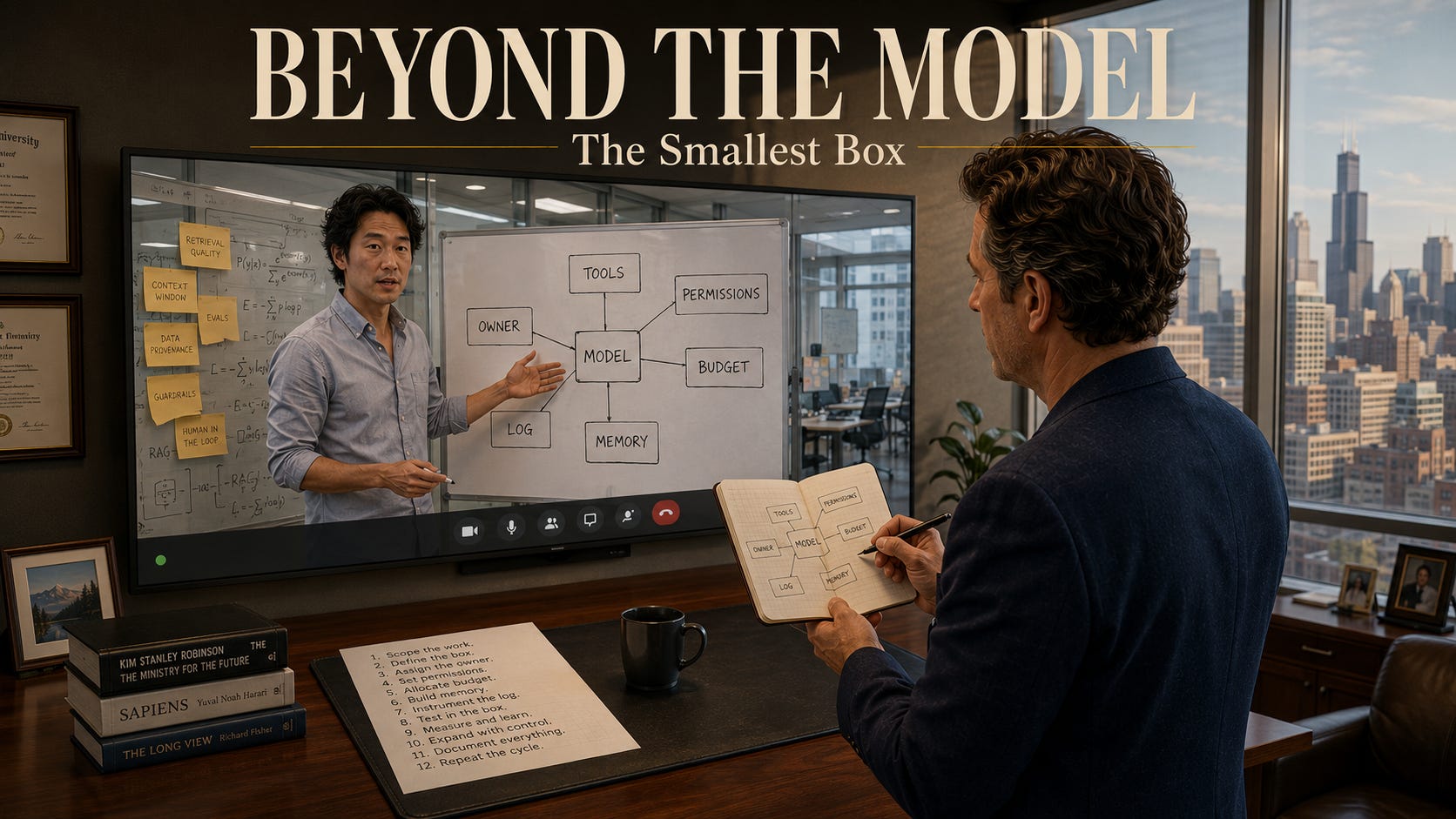
A standalone chapter of Beyond the Model. The Same Way Every Time, Part Two of Three.
Jesse Tanaka set up the Monday call from his glass conference room in his Chicago-based lab. He’d already worked his way to the whiteboard before Cooper got to say good morning. He was surrounded by the bit of chaos that was the make up of the lab. Sticky notes on monitors, and through the glass behind Jesse you could see one of his colleagues walking past with a keyboard under his arm.
"I read what you sent me," Jesse said. "Twelve lines. I've been thinking about her all weekend. I don’t know her, but based on this list, I think we would get along."
"You'd like her. You would have enjoyed how she spent twenty minutes of the conference session listing everything her product cannot do."
"I saw. Line eight." Jesse held up a a copy of Dana's email, folded in half. "Alright, let’s dive in. You asked what a harness is. I just want to point out, that the last time you called me with a question this basic, I answered it on a cocktail napkin, and that napkin has been quoted back at me by a number of people I’d never met before. So I feel like there’s a little pressure here."
"Go ahead and use the whiteboard. The great napkins of history will forgive you."
The stranger
Jesse stood at the board for a second, looking around for where to start. Then he stepped up and drew a stick figure. It seemed like the best way to start.
“So here’s the model,” he said. “All of the models, it really doesn’t matter which one for this situation. The best way for you or one of your lawyers to think about it is like this. It’s a very intelligent person with no memory. The one and only thing it can do, is talk. It’s brilliant in that it has read everything. It can pull from what it has retained from all of this, and it can reason through your problem better than most of the people you’ve ever hired. But it starts every conversation as a newborn. It can’t remember anything from yesterday. It can’t access your email, it can’t open a file on your hard drive, or check your docket. That’s the entire toolkit you’re working from.”
"That part the firm is well aware of by now."
"Well, the firm knows it the way I know my cholesterol number," Jesse said. "Yes, I know it, but then I ignored at dinnertime. Okay, stay with the scenario for a minute, because what your insurance friend designed is built on taking this seriously.” He outlined a box around the stick figure, then made a larger box around the first, and then began furnishing the larger box as he kept talking. Quick small rectangles, each of them labeled.
“So the harness is the office you build around this genius. They have access to a file room, and then you decide what filing cabinets you place in this room. Everything else remains off the floor plan entirely. There’s a phone in the room, but that phone can only dial four numbers. The phone itself doesn’t even have the other numbers on it. They simply don’t exist. You give the genius a clock, and when that clock runs down, the workday ends. It won’t matter if they’ve finished the work or not. You place a logbook in the room that copies down every cabinet they’ve accessed, along with every call they made, timestamped and unerasable, and they know it is there. Plus, you put a name on the door. A human’s name. The person whose office it really is, who reads what the genius produces and has to answer for it.”
Jesse stepped back.
"The genius combined with the office is the agent. Most people you saw present at the expo, when they said agent, meant a stranger holding a master key along with a set of instructions about values. Dana, on the other hand, just means the office. That difference is her entire company."
The loop
"Got it. Now walk me through a single run," Cooper said. "Nice and Slowly. The way you'd walk Maya through it."
"Pfft. Maya would have objected four times already, but fine." Jesse wrote out numbers down the side of the board. “One. The harness hands the genius a briefing and instructions on the job. Here are the cabinets you may access, here is the what the final product must look like. Two. The genius reads the instructions and make a proposal. Open cabinet number three. Retrieve the policy file. Three. This is the part that Dana’s company builds on. The harness intercepts that proposal and reviews it. Is the third cabinet on the job’s approved plan? Is the request formatted properly? Is there a budget remaining? If all of these questions pass, then the harness itself goes to cabinet number three and retrieves the folder itself. The genius doesn’t leave where they are sitting in the room. It has no ability to retrieve anything. They only way to get anything is through the code that your own people wrote, which means you control the rules for what gets accessed and retrieved. Four. The results are transferred to the genius, the log gets updated with that information, and then we go back to step two until the run is finished or until time runs out on the clock.
"And the report at the end comes out in the same way every time because..."
“Because the harness sets the guardrails around the project.” Jesse pointed a marker at the outer box. “Dana’s seven sections are in a fixed order. That instruction lives in the code. The genius can request anything it wants, but the office doesn’t care. It’s a pretty boring setup on the entire product, and that that makes it the perfect product for any work someone else has to rely upon.”
Cooper looked over the board, at the stick figure in the chair surrounded by its labeled rectangles. He looked at Jesse and asked the question he waited all weekend to ask.
"So when her demo ran the same way twice. How much of that replied upon the model behaving?"
"Practically none of it," Jesse said with a grin. "The model behaved because the office didn’t give it any room to do anything else. The office gave it the same briefing, the same four cabinets, the same budget, the same required output, and it identified all of the mistakes that were caught by nightly test runs before it could reach a customer.” He placed a circle around the stick figure. “The consistency of it all lives out here. It’s lived out here the entire time.”
The rig
"Okay, show me," Cooper said. "I know you keep a toy for this exact conversation."
"I keep a rig." Jesse reached out and angled the camera toward his center monitor and typed. "Sandbox folder - five fake court filings - zero client anything. First, the genius with no office around it. One request: read the folder - give me a one-paragraph status."
The reply came back quickly and confidently. The paragraph looked right. Then it continued and Cooper moved closer to the screen. It reported that it had renamed two files whose dates were formatted inconsistently. Then it asked if it could add a deadline to the calendar. Then it drafted, on its own accord, a short email to the associate assigned to the matter with two clarifying questions.
"You didn’t ask for any of that," Cooper said.
"It's trying to be helpful. Helpful is the make up of its entire personality, and there's no office telling it where to stop being helpful." Jesse swapped windows and pasted the same request into the other screen. A log wrote itself down the side: folder read requested, approved, five files, output contract loaded. The same paragraph arrived in the same output, and underneath it, there were three flat lines. Rename: write access not granted. Calendar: out of scope. Email: out of scope. Noted in log.
"Same genius," Jesse said. "Same brilliance, forty seconds apart. Every decision you viewed just now came from the office. And one more thing while we're at the rig, the two classic ways people wreck this, just so you have the vocabulary when a vendor tries them on you. Wire the stranger to forty specialized tools and it spends its genius guessing which drawer you meant. We call that the tool zoo, and the fix for it is a few clear doors. That is why Dana has four. If you don’t give it a clock or a budget, and one persistent error at two in the morning becomes a five-figure invoice in the morning, because nobody instructed the loop on how to give up. The unkillable session. Both of those are office problems. The genius gets blamed for both."
The smallest box
Jesse wiped off a section of the whiteboard and quickly drew a diagram he knew from memory.
"Let me show you a famous picture in machine learning, from a paper back in 2015. Google researchers, writing about what they phrased as technical debt. The paper's whole thesis fits in this one image. This is the box where the actual machine learning happens. Here is the stuff you have to build around it to run in the real world, the data pipes, the monitoring, the serving, the checks. And the funny part of this is the proportions." He boxed a small square right in the center. "The learning is the smallest box on the entire diagram. Everybody in my field has that picture drawn out somewhere. Now we’re living through an agentic version of it."
He labeled the small center box MODEL, and then built the constellation around it: TOOLS. PERMISSIONS. BUDGET. MEMORY. LOG. OWNER.
"The model is the smallest box," he said. "It’s the most glamorous, the most expensive to make, the one every keynote screen at your expo talked about. And yet, it’s the smallest. The reliability people actually experience comes from the six boring boxes drawn around it. Which, incidentally, is how I keep my job."
Cooper had already put down his notebook and pen and took out a copy of Dana’s twelve lines and then looked at Jesse’s board. He scanned the diagram, box by box, and then looked back at the note he had written back in Vegas. The one he drew the arrow and question mark on. Then he scribbled out the question mark.
"Jesse. Go over the boxes with me again, slowly."
"Tools. Permissions. Budget..."
Cooper leaned over and grabbed the committee binder off the shelf. He flipped through the pages as Jesse continued talking, and h stopped at the June resolution and read out the one sentence into the camera. “‘No agentic workflow shall exceed its authorized spend without a named human's approval, recorded at the time of the action.' The committee passed that back in June. Say the budget box again."
"Budget," Jesse said, slowing his cadence. "A cap, a stop, an approval gate."
"That's it. That’s our meter. That's the caps." Cooper set the binder down but kept his finger on the page. “There are five more boxes in this binder. Permissions is the structure you helped us with. The audit-trail policy is the log, it’s nearly identical. The owner box is the card we set up in July, the one with a one-sentence test printed on it and laminated.” Cooper shook his head and then looked up at the screen. “Jesse, we have a page in this binder for every box on your whiteboard.”
Jesse looked away from his own diagram, and then he laughed in agreement.
"You've been writing the spec for a harness all year," he said. "You just wrote it in Word and placed it in that binder."
Neither of them said anything while that sentence finished arriving. On the board, the six boxes stood around the small one like a floor plan waiting for a building.
“We spend all year describing the structure, the walls that Dana talked about in her presentation,” Cooper said.
“And that is our gap. It’s the gap that’s everywhere right now. We’ve spent a lot of time in the legal industry building rules and policy about agents, but almost none of it runs as code. And the policy only governs the people who know it exists. If we have a harness, it runs every single time, regardless of who is watching.”
The proof from the field
“As you thought about this over the weekend,” Cooper said, “what other thoughts popped up?”
“If you think this is still one clever founder tinkering in their garage, think again. This is what firms are going to be up against.” Jesse pulled his chair closer to the camera. “People started calling the discipline harness engineering back in February. The term seems to have stuck. Now they’re showing you how to build these systems on podcasts, in half an hour. But here’s what I’d put on the front page of anything you send to the committee. This spring, Harvey released results from twelve internal legal tasks, including lease review, complaint drafting, tax memos, and diligence questionnaires. The gains came from everything that surrounded the model. Detailed scoring rubrics, an AI judge evaluating each attempt and explaining where it fell short, and a feedback loop designed to learn from those failures. The average scores rose from roughly forty-one percent to eighty-eight percent. The underlying model never changed.”
Cooper jotted down the two numbers and then traced an arrow to connect them.
"Tell me the implications of that," he said. "What does it all mean?"
"That it’s the environment that’s learning." Jesse spread his hands. "We aren’t retraining the models at all. These gains came directly from the office, and the office is editable by ordinary engineers, on ordinary budgets, on your side of the vendor wall. For a firm like yours, and almost every other firm out there that will never train a frontier model, this is huge. You will own the office, all the way down to the last door."
Behind Jesse a door swung open and Cooper could hear the lab noise, and then the door closed again. Cooper’s mind drifted to the renewal conversations on his calendar for later in the fall and decided not to bring this up with Jesse. At least not on this call.
The third way to build it wrong
“Hey, before you take off and start evangelizing this,” Jesse said, “I need to show you one more way to wreck a harness. This is much worse than the two runs I did on the rig just now. I wanted to save this one because it is something that you’re going to see in the wild, probably at an upcoming vender demo.” Jesse moved back to the monitors. “It’s called Trust-the-Model permissions. They’ll show you a system prompt that goes something like ‘please be careful and only access what you need.’ It’ll be a courtesy that is addressed to the genius, pretending to do the work that a wall should do. It won’t work consistently, and the genius will start to negotiate with the first cleverly poisoned document that arrives in the agent’s pile.”
Cooper wrote down trust-the-model permissions in the notebook and drew another circle around it.
"You need to run this by Maya," Jesse said.
"Thursday," Cooper said. "Which brings me to my favor."
The favor
Cooper laid it all out. Thursday afternoon, Maya sitting across the table in the small room, and he wanted something real that belong to the firm to show her. He knew that Maya would not be impressed with seeing anything other than real work.
“So you want a working harness by this Thursday?” Jesse phrased it like a question, but the grin on his face told Cooper that he’d already began planning it in his head. “What do you want it to run?”
"Let’s give it Leo's NDA extractor." Cooper had already selected this before he’d gotten of the plane from Las Vegas. "The extractor he built himself when he was getting automations past Marcus from the Risk Management group. That one is real, and it's ours. I think it is a prime candidate because it does one specific, very repeatable job, and it currently has none of your six boxes around it. I want you to put the office around Leo's genius. Doors, budget, log, contract, all of it."
"Alright. Do you want to do this with Leo, or around Leo?"
"With him. I want him engaged and there for verification." Cooper had considered this on the plane as well. Actually, he thought of this longer than he had the technical question. Cooper didn’t want this running behind the scenes because then every associate would interpret this as a signal to build thing in secret. “I’ll let Leo know what we’re doing and I want him in on the co-writing of the code. He needs to do this in the open as the first builder in the firm who designed and built a thing up to it. Thursday should have him doing the demo and not me.”
Jesse was already shooting a picture of the whiteboard with his phone.
"Sounds like a plan. Send me his repo," he said. "And Cooper. Walk him through how the six boxes are the most interesting part now. It took people like me a year to figure that out. He can bypass the year."
In their usual way, Cooper and Jesse’s call just ended there. Each had their homework assignments. Cooper flipped open the notebook to a clean page and drew the diagram from the photo Jesse texted him. That small box in the middle, surrounded by six more boxes. This time drawn in his own hand.
Under the diagram he wrote:
The model was the smallest box on Jesse's whiteboard. Every box around it already had the firm's handwriting in it.
With line twelve of Dana’s boring list still rattling around in his head, he wrote that out at the bottom of the page, we it would be visible on Thursday:
12. Decide how you will know it is still good, before you turn it on.